
Intentional Design: Reflecting on the Details of My Prototype Artifact


February 15, 2026
Designing this professional learning prototype required me to think beyond delivering content and instead focus on designing an experience. Drawing from The Design of Everyday Things by Don Norman and Creative Confidence by Tom Kelley and David Kelley, I approached this artifact not simply as a course, but as a human-centered system intended to solve a persistent instructional problem: the disconnect between research-based dyslexia practices and everyday classroom instruction.
This week's journal reflection captures how principles of human-centered design, creative confidence, and adaptive learning technologies shaped the development of this prototype at an extended abstract level.
Human-Centered Design as the Foundation
Norman (2013) argues that “two of the most important characteristics of good design are discoverability and understanding.” As I built on the ideas for this professional learning course, I continuously asked:
Can educators easily determine which actions are possible?
Do they understand how to move from student data to instructional decisions?
Professional learning often overwhelms teachers with dense information and disconnected strategies. To do the opposite, this prototype will be structured with clear pathways to analyze data, select a strategy, implement, reflect, and adjust. This sequence enhances discoverability and supports understanding by the educator.
Norman (2013) reminds us that design is concerned with “how things work, how they are controlled, and the nature of the interaction between people and technology.” In this prototype, the interaction is not just between teacher and content, but between teacher, student data, instructional technology, and reflection tools. The system must clearly communicate what action is possible at each step.
The artifact reflects human-centered design (HCD), which Norman (2013) describes as starting with “a good understanding of people and the needs that the design is intended to meet.” Teachers often feel underprepared to interpret reading assessment data for students with dyslexia. Instead of assuming what teachers need, the course design intentionally centers on authentic challenges they experience, including difficulty connecting assessment results to instruction, uncertainty about implementing structured literacy practices, and limited sustained coaching following workshops. By observing these real challenges, the prototype aligns with HCD principles.

Affordances, Signifiers, and Mapping in Course Design
Norman (2013) differentiates between affordances, which represent what actions are possible, and signifiers, which communicate those actions, and within the digital modules of this course, downloadable templates signal usability, reflection prompts signal intentional pause points, and case-study analysis signals application rather than passive reading.
Clear mapping with “spatial correspondence between the layout of the controls and the devices being controlled” will influence the structure of the modules (Norman, 2013). Each section will mirror the instructional decision-making process teachers already use, creating intuitive alignment between professional learning and classroom practice.
Feedback was also intentionally designed. Norman (2013) emphasizes that feedback must be immediate and prioritized. In this prototype, there will be embedded checks for understanding, automated progress indicators, and guided reflection prompts to provide ongoing feedback. This prevents cognitive overload while maintaining engagement.
Experience Over Information
Norman (2013) argues that great designers create pleasurable experiences, not just functional systems. Engineers may resist the word experience, but experience determines how interactions are remembered. This insight reshaped my thinking: If teachers leave professional learning feeling overwhelmed or judged, the learning will not transfer. This prototype course, therefore, emphasizes practical tools rather than theory-heavy lectures, iterative reflection instead of compliance-driven tasks, and authentic student scenarios in place of abstract descriptions. The ultimate goal is to ensure that educators feel capable and empowered rather than evaluated.
Creative Confidence Prototyping
From Creative Confidence, Kelley and Kelley (2013) emphasize a “do something” mindset. Rather than attempting to cure systemic literacy inequities in one sweeping solution, this project narrows the goal: build teacher capacity in dyslexia-responsive instruction through a structured, scalable model.
The authors encourage tackling “a doable piece of the problem” and building prototypes as early working models. This artifact is intentionally framed as a prototype and not a finished product. It will embody experimentation.
Prototyping forces decision-making. It also invites feedback. As Kelley and Kelley (2013) explain, experiments naturally involve failure, but reframing failure as iteration increases long-term success. This mindset is embedded in the course structure itself: teachers are encouraged to try strategies, collect data, and refine instruction rather than expect perfection.
A powerful insight from Kelley and Kelley (2013) is that good prototypes tell a story. This course tells the story of a teacher analyzing a student reading profile, selecting structured literacy strategies, implementing instruction, and seeing growth. The participant becomes part of that story, increasing engagement and ownership.
Technology and Motivation
Wang et al. (2020) highlight that mobile and web-based e-learning systems can detect and respond to users’ motivational states in real time. While this prototype does not yet incorporate advanced AI-driven motivational detection, it is designed with adaptability in mind through self-paced modules, interactive case studies, embedded reflection checkpoints, and data-informed decision simulations.
The long-term vision includes integrating adaptive elements that respond to participant engagement patterns. If teachers struggle with a data analysis module, the system could provide additional scaffolds. This aligns with Wang et al.’s (2020) findings that dynamic responsiveness enhances motivation, effectiveness, and enjoyment.
Extended Abstract Insight: Beyond the Immediate Context
At the extended abstract level, this prototype is more than a professional development course. It represents a shift in how we conceptualize instructional improvement. Instead of delivering strategies, this led to expecting implementation. This model will promote observing needs, designing instruction, testing, reflecting, and refining.
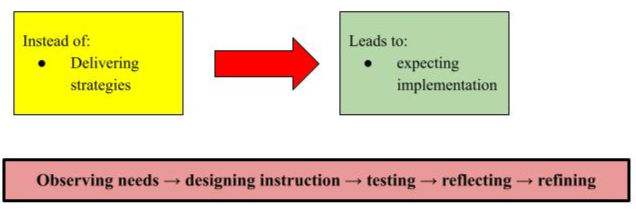
This mirrors both human-centered design (Norman, 2013) and creative experimentation (Kelley & Kelley, 2013). It also aligns with emerging intelligent systems that adapt to user needs (Wang et al., 2020).
The deeper insight is this: Teachers must see themselves as designers. When educators adopt a design mindset, they move from passive recipients of training to active agents of instructional change. This prototype intentionally cultivates that identity shift.
Final Reflection
Design is not about aesthetics; it is about meaningful interaction. Norman (2013) reminds us that good design communicates purpose and possibility. Kelley and Kelley (2013) remind us that action builds confidence. Wang et al. (2020) remind us that technology can support motivation when thoughtfully designed. This professional learning prototype integrates these principles to address a real instructional gap in dyslexia-responsive literacy instruction. It prioritizes clarity, usability, iteration, and reflection. Most importantly, it places teachers, and ultimately students, at the center of the design process.
References
Kelley, T., & Kelley, D. (2013). Creative confidence: Unleashing the creative potential within us all. Currency.
Norman, D. A. (2013). The design of everyday things (Revised and expanded ed.). Basic Books.
Wang, R., Chen, L., & Solheim, I. (2020). Modeling dyslexic students’ motivation for enhanced learning in e-learning systems. ACM Transactions on Interactive Intelligent Systems, 10(3), 1–34. https://doi.org/10.1145/3341197


Comments